
From Shattered to Sacred: A Journey Through the Silence
I didn’t imagine this would become my life’s work.
When I first lost a pregnancy, I told myself I was still young. I remember the coldness of the hospital room when I was 29, being told my baby’s heartbeat had stopped, only for the doctor to casually suggest I “hold the baby in” until Monday to save on weekend medical costs.
When I lost another, I told myself to be strong and try again. I remember the paralysing guilt of my third pregnancy, watching my baby move on a live monitor, knowing I had to make the agonising choice to let her go because her organs had formed outside her.
When I lost a third, something inside me quietly broke, not loudly, not dramatically, but in a way that changed how I moved through the world.
From the outside, I was “functioning.” Inside, I was carrying grief that had no language, fear that lived in my body, and a growing mistrust of the one place I needed to feel safe: myself.
Doctors checked my body.
Friends offered well-meaning words.
Life kept moving.
For a long time, my life felt like a series of “silent goodbyes.”
I have been where you are.
I have felt the shock of miscarriage, and the complex, heavy layers of a termination for medical reasons (TFMR).
I loved my babies deeply, and that love didn’t disappear just because their lives were short.
What is surprising isn’t just the sadness; it was the isolation.
The quiet guilt.
The shame that crept in at night.
The unspoken question so many of us carry after loss:
Was it my fault?
Can I trust my body again?
Who am I without a child?
How I wish I could be like my friends who have kids!
When is my turn?
The other friend wasn’t even trying. How come it’s so easy for others?
What if I could never have kids?
Grief doesn’t just live in the mind.
It settles into the nervous system.
Into the breath.
Into how we brace for the future.
For a long time, I didn’t know how to “heal.”
I just got back to a busy life, working, functioning, and socialising. That seems to be the “correct” way to be occupied and heal at that time.
My turning point didn’t come from someone fixing me.
It came from being met, slowly, respectfully and learning how to stay present with my grief instead of fighting it.
I began to understand that grief is not something to overcome.
It is something to be integrated.
Like kintsugi, the Japanese art of repairing broken pottery with gold, the cracks didn’t disappear.
They became part of the story.
Later, when I became pregnant again, there was a lot of deep work.
Every scan carried history.
Every sensation woke memory.
And yet, this time, I wasn’t living in constant fight-or-flight.
I had learned how to work with my body, not against it.
How to notice fear without letting it run the show.
How to breathe, regulate, and choose presence, even when certainty was impossible.
That pregnancy ended with the birth of my child Elvanna.
That is when I knew:
Loss does not disqualify you from hope.
Grief does not mean you are broken.
And healing does not mean forgetting.
Today, I support women and couples who are living in the after — after miscarriage, after stillbirth, after termination, after infant loss, after IVF heartbreak.
This is a heart-centred and trauma-informed work.
Some women go on to conceive. Some don’t.
Yet, all leave with steadier ground beneath them.
With this support, 70% of the women I coach have successfully carried a pregnancy to birth (2021-2025). This number is not a cold guarantee.
It is a reflection of what unfolds when the mind and body can finally rest out of chronic anxiety and into regulated resilience.
If you are carrying a fear that lives in your bones, the kind that makes every scan feel like a countdown, or every quiet hour without a kick feel like a crisis, please know that there is room to change how you move through it.
My work is not about “fixing” your grief.
It’s about helping you build a container where that grief is held, and courage can grow.
It’s about teaching your nervous system new rhythms so that your decisions come from steadier ground.
Many come to me saying:
“I look okay, but I’m not.”
“I want a baby, but I’m terrified.”
“I am just angry, jealous and sad.”
“I don’t know how to move forward.”
The 12-Week Kintsugi Journey was created for this exact place, because I searched for a “safe container” in Singapore and Southeast Asia and found a void.
After losing three angel babies, I realised that my grief was simply “intense love with nowhere to go.”
I stopped trying to “get over” it and started learning how to integrate it.
I realised that my body hadn’t failed me; it was carrying a story that needed a safer space to be told.
You shouldn’t have to navigate this wilderness alone, and you shouldn’t have to suppress your story to make others comfortable.
If this story lands somewhere inside you, I’m here.
Grounded, Present and Emotionally Regulated Birth
The Morning Everything Changed
We weren’t trained for this.
It was just the three of us at home — me, my husband, Lok, and our eldest, Elvanna.
It was a morning that unfolded with a speed. I will never forget.
At 10:00 AM, I called the hospital.
My contractions were 15 minutes apart.
They told me to wait until they were five minutes apart before coming in.
I lay out my purple yoga mat, moving between a squat and all fours,
listening to my hypnobirthing audio: “Trust your body, trust your baby… in a while, more, you will welcome your baby.”
My husband timed each surge with a pen and paper while I stayed deeply attuned to my breath.
Twenty minutes later, at 10:20 AM, the surges were five minutes apart.
I called again to reserve the water-birth room.
The nurse asked if my water had broken and how far away we were.
I told her we were 30 minutes out, and the water bag had not broken. She said, “Okay, you can slowly make your way here.”
The second I put the phone down, I looked at Lok.
“The baby is coming,” my voice was calm but certain.
“Okay, let’s rush to the hospital,” he said.
As I was sensing my body, I replied. “No, she is she’s coming now.”
His mind might have had thousands of questions, yet he just calmly asked, “What do we do?”
“We just have to deliver her,” I said simply.
“My hands are dirty,” he claimed. “Go wash them.”
While he washed, I kept breathing deeply in and out in a squat, letting gravity work its magic.
We were two people with no midwife, relying on the instinct and faith that lived in our bones.
My husband had missed our first birth, so this was his first experience — a surprise, a task, and a miracle all at once.
“I can see the head,” he whispered.
“Can you see the body?” The baby was not visible to me, as my big belly blocked my view while I was squatting.
“No.”
“Try to pull.”
“Oh, that doesn’t feel right. Let me breathe out more.”
I told the baby, “Work with mummy”.
With one more breath, miraculously, she was here.
I can’t ask for better teamwork.
He caught her from behind me.
We heard her first cry, and a sense of joy folded through us like warm light.
My feet were wrapped in the cord, and surprisingly, there was no blood on the mat.
It was 10:40 AM.
From that first call to her first cry, only 40 minutes had passed.
Elvanna was in the living room had no clue. That was how peaceful the atmosphere was.
Daddy said: “I like to show you something” while he carries her in.
The minute she saw her little sister, her face opened into breathless joy.
It was a moment of simple wonder that made the day magical.
Having a little sister is her dream come true.
The Paramedic and the Paradox
When the paramedics arrived, one was a mother of two.
She checked the baby’s oxygen level, heartbeat, and temperature.
She checked in on how I am feeling and my vitals.
Then she turned to my husband and said, “Can I have a glass of water? I am feeling hot”.
She turned to her colleague, “Can you call a second paramedics”
I was curious why a second paramedic? But did not raise any questions or alarm.
I remained in “zen mode,” enjoying the moment.
I noticed, deeply, how different this birth felt from my last. My previous delivery had landed me in the NICU with heavy bleeding and a warning that my uterus might need to be removed.
Beyond that, I carried the weight of three pregnancies that didn’t continue, a body that had been through the harshest of contingency plans.
It would have been easy to spiral into a worst-case scenario.
I could have been drowning in fear as my baby arrived on a yoga mat with no medical help.
Instead, something else moved through me: calm, focus, and a kind of trust that came from doing the internal work — the nervous-system practices, the somatic awareness, the steadied breath.
I was present.
I was not operating from fight, flight, or freeze.
I was moving with my body. I trusted myself, even after I had known so much grief.
The female paramedics couldn’t come back inside. She was having a panic attack.
We waited for the second ambulance.
We cut the umbilical cord two hours later.
If you’ve been through multiple losses, you might read this and think it’s impossible.
Or you might feel a thin thread of something else—curiosity, maybe, or the tiniest permission that you might not always have to live in fear.
I don’t promise outcomes. Pregnancy and birth are tender and unpredictable.
But in my coaching work, I have seen a pattern:
When we remove the emotional blocks that keep the nervous system stuck in alarm, possibility shifts.
When we practice somatic awareness and learn to steady the body from the “bottom up,” we move out of survival mode.
We can talk about what it looks like to find calm in your current or next possible pregnancy.
There is no pressure, only a safe space waiting for you.
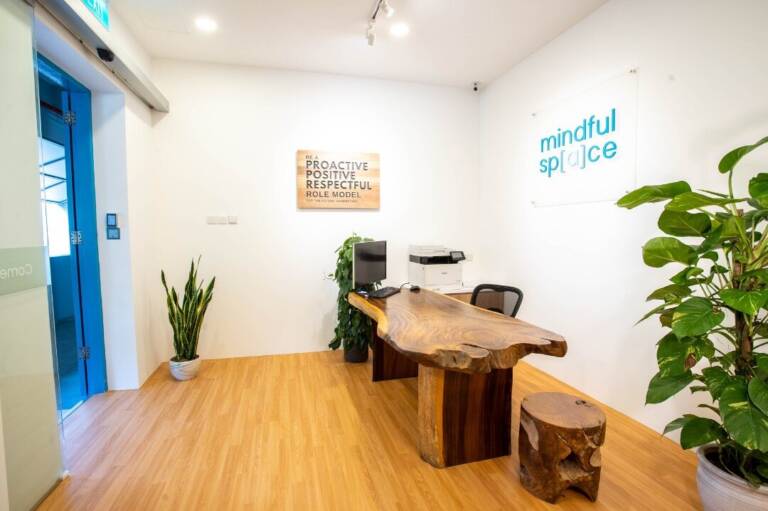
Why I set up Mindful Space and became a parenting coach
I always wanted to be a teacher since young. With over 20 years of experience in Canada, Australia, Malaysia, and Singapore, I have the opportunity to gained valuable insights into the needs of both children and adults in various educational settings from both Western and Eastern culture.
As a mother of two beautiful daughters (and three angel babies),
I was a tertiary lecturer at an American College and also an enrichment teacher for local Singapore preschools. I enjoy the experience of witnessing how children grow, hence teaching pre-schoolers to college students allows me to see different transformation.
What my years in Mindful Space taught me

We develop modern mental treatment.

It’s an inviting, safe and calm space. The transition from story sharing to TRE is good as it allowed release. I am comforted by your words. an invitation to this circle has allowed me to see myself.
Su. O
The session was held in a very comfortable environment where I felt safe.
It was in a space where I felt I could be vulnerable and it’s okay.
Thank you for letting me join the session and helping me grow stronger and braver.
WY
The session has made me realize that I’m not alone in the journey.
I met many fabulous people in the session who can empathise all the many emotions and confusions I went through.