

I remember the room’s coldness.
I remember being told my baby’s heartbeat had stopped, delivered in a tone so emotionless it made the moment feel even colder.
It was a Friday.
I remember the casual suggestion by the doctor to “hold the baby in” until Monday, to save on weekend medical costs.
I remember thinking,
What if he made a mistake?
Why did this happen?
There were no words of comfort.
I was a medical patient.
And the medical journey did not extend to emotional care.
I remember the shock.
The tears that wouldn’t stop.
My legs were trembling as I walked out to the reception, surrounded by pregnant mothers and newborn babies.
The receptionist calmly scheduled my D&C for Monday.
And yet, a part of me kept hopinghe had seen it wrongly.
I decided to seek a second opinion at another hospital. At A&E, another doctor confirmed the same news.
But this time, she was gentle.
She sat with me.
She explained that it was most likely due to chromosomal abnormalities.
She told me it was not my fault.
The diagnosis was the same.
But the emotional care was completely different.
And that difference mattered.
Some losses don’t just break the heart.
They fracture trust in systems, in safety, in our own bodies.
When emotional care is absent, the body holds shock, fear, and unanswered questions long after the appointment ends.
Medical treatment addresses the body.
But grief requires emotional safety.
This realisation shaped something deeply – my life’s work as a pregnancy loss coach.
Yet somehow, life around me kept moving forward as if nothing had happened.
From the outside, I was “functioning.”
Inside, I was carrying grief with no language.
If you are surviving but not really living,
I want you to know, I have been there.
If you’re reading this, you might be in that same surreal space. The one where everyone expects you to “bounce back,” but you’re still trying to understand what just happened to your body, your baby, your future.
You’re not alone in this. And more importantly, you don’t have to navigate this alone.
The Silence That Surrounds Miscarriage
Here’s something that surprised me when I began my work as a pregnancy loss coach: 25% of all pregnancies end in loss, yet 7 out of 10 parents leave the hospital feeling emotionally abandoned. They are medically discharged, with no emotional care or follow-up.
Most of us suffer in silence. We’re told it’s “common,” as if that somehow makes it hurt less. We’re told to “try again,” as if the baby we lost was simply a practice round.
But you know the truth. This loss is real. Your grief is real. The dreams you had, the name you might have chosen, the future you imagined, all of it matters.
In many Asian cultures, including here in Singapore, Malaysia, and throughout Southeast Asia, we’ve been conditioned to suppress our emotions. We pack our schedules, return to work quickly, and smile when people ask how we’re doing. We’ve mastered the art of appearing “fine” while our hearts are breaking.
I’ve learned through my own three pregnancy losses and through supporting bereaved parents since 2011: Time alone doesn’t heal grief. Time with intentional support does.
Why Traditional Support Often Falls Short
After my first miscarriage, well-meaning friends and family offered advice:
- “Everything happens for a reason”
- “At least you know you can get pregnant”
- “It wasn’t meant to be”
- “You’ll have another baby”
These words, though meant to comfort, often made me feel more alone.
Because they didn’t acknowledge the very real loss I was experiencing right now.
You might have noticed that traditional grief support often focuses on the death of a person everyone knew. But pregnancy loss exists in a unique, liminal space. Your baby existed in your body, in your heart, in your plans, but not in the way that others could witness or understand.
This is why specialised pregnancy loss support is so important.


What Makes Pregnancy Loss Coaching Different
As the first ICF-certified pregnancy loss coach in Southeast Asia, I understand what bereaved parents truly need. It’s not just someone to talk to (though that matters). It’s someone who can help you:
1. Regulate Your Nervous System
After a miscarriage, your body often stays in a state of high alert. You might experience:
- Panic, jealousy or anger when you see pregnant women, or see baby photos on social media
- Anxiety that something is “wrong” with your body
- Flashbacks to the moment you learned about the loss
- Physical tension that won’t release
- Sleep disturbances or nightmares
These aren’t signs that you’re “not coping well.”
There are signs that your nervous system experienced trauma and needs support to regulate again.
Through somatic practices like Tension Release Exercises (TRE®) and mindfulness, pregnancy loss coaching helps your body move out of the fight-or-flight-freeze state. When your nervous system feels safe again, your mind can begin to heal.
2. Process Grief Without Shame
In my coaching practice, there’s space for all of your emotions:
- The anger that this happened to you
- The jealousy when you see pregnancy announcements
- The guilt, wondering if you did something wrong (you didn’t)
- The fear of trying again
- The profound sadness that comes in waves
Pain without shame. Grief without judgment. This is what healing looks like.
Unlike traditional therapy that might focus on “moving on,” pregnancy loss coaching acknowledges that you don’t move on from a baby you loved. You learn to move forward with your grief, integrating this experience into your story rather than being defined by it.
3. Reframe Your Inner Narrative
After loss, many women tell me they hear a cruel inner voice:
- “My body failed me”
- “I’m broken”
- “I’ll never be a mother”
- “This is my fault”
Through ontological coaching, we explore the relationship between your body, emotions, and language. We look at the stories you’re telling yourself and gently ask: “Is this story serving you, or is it keeping you stuck?”
When you shift your narrative, you shift your possibilities. From “my body failed” to “my body experienced something beyond my control, and I’m learning to trust it again.” This isn’t toxic positivity, it’s reclaiming your power.
4. Prepare for What Comes Next
Whether you’re planning to try again or not, life after miscarriage requires rebuilding your sense of safety and self. Pregnancy loss coaching helps you:
- Identify what you need (not what others think you need)
- Communicate your boundaries with family and friends
- Navigate medical appointments without re-traumatisation
- Make decisions from a grounded, regulated place
- Build resilience for whatever path you choose
You carry a responsibility that was never yours to hold.
You punish yourself for an outcome you could not control.
And you grieve not just your child, but the safety you once felt inside yourself.
The Kintsugi Journey: Healing Through the Golden Joinery
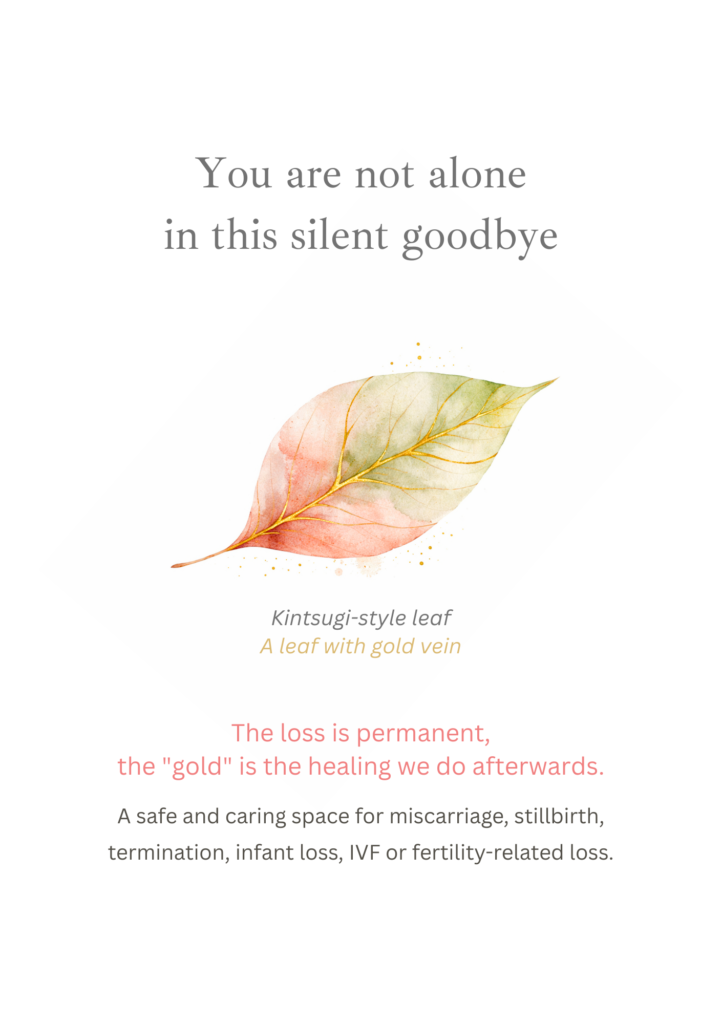
In Japan, there’s an art form called Kintsugi—when pottery breaks, they mend it with gold, making the piece even more beautiful because it was broken.
This is the heart of my signature program, the Kintsugi Journey.
Over 12 private sessions spanning 3-6 months, we create a sacred container for your healing. This isn’t a quick fix. It’s a deep, transformative process that addresses:
- Your body (through somatic work and nervous system regulation)
- Your emotions (through the evidence-based Grief Recovery Method®)
- Your story (through ontological coaching and creative expression)
Here’s something I want you to know: 70% of the women I coached between 2021-2025 went on to carry a pregnancy to birth.
This statistic isn’t a guarantee—pregnancy is tender and unpredictable. But it reflects what I’ve witnessed repeatedly: when we release the emotional blocks keeping the nervous system in chronic anxiety, when we help the body feel safe again, possibility shifts.
What Healing Actually Looks Like
Let me share what one of my clients, Dr. Tong (featured in The Straits Times), experienced:
After four miscarriages, she felt profoundly broken. During our work together, we spent a session walking in nature at East Coast Park. In that quiet space, she said something shifted:
“In the quiet of nature, not striving and not trying to achieve anything, I realised that I was enough. I had done my best… I saw the children I lost in every child playing at the beach. They seemed to be in the sky when I looked up. I realised that my babies are in my heart.”
This is what I mean by healing. Not forgetting. Not “getting over it.”
But finding a way to hold your grief with tenderness while also living your life.
How to Know If Pregnancy Loss Coaching Is Right for You
Coaching might be the right fit if you:
✓ Function well on the outside but carry grief quietly inside
✓ Feel stuck in anxiety, numbness, or fear around your body
✓ Want to process your loss deeply, not just “manage” symptoms
✓ Are ready to invest in yourself with intention and care
✓ Want to prepare emotionally for a future pregnancy (if that’s your path)
Coaching might not be right if you:
✗ Are looking for quick coping tips or surface-level support
✗ Need medical or psychiatric intervention (I work alongside these professionals, not instead of them)
✗ Prefer large group programs over intimate, private sessions
Finding Support in Singapore, Southeast Asia, and Globally
Whether you’re in Singapore, Malaysia, Hong Kong, Indonesia, Thailand, the Philippines, or anywhere in the world, specialised pregnancy loss support is available. I offer:
- In-person sessions in Singapore
- Online sessions globally (I’ve supported clients across Asia)
- Private 1:1 coaching for deep, personalised work
- Small group programs for those who want community alongside individual healing
The beauty of online support is that you can receive trauma-informed care from your own home, in your own timezone, wearing comfortable clothes, with a cup of tea in hand.
What Happens in a Clarity Call
If you’re feeling a quiet pull toward support but aren’t sure where to start, a free 20-minute clarity call is the perfect first step.
In this call, we’ll:
- Create space for you to share what you’re experiencing right now
- Explore what kind of support would serve you best
- Discuss whether the Kintsugi Journey or another program aligns with your needs
- Answer any questions you have about coaching, the process, or my approach
There’s no pressure, no sales pitch. Just a warm, honest conversation to see if we’re a good fit for this co-partnership.
Your Healing Journey Starts Here
I know what it’s like to feel lost after a miscarriage.
To wonder if you’ll ever feel like yourself again. To be afraid of hope because hope has hurt before.
I also know what it’s like on the other side, not without grief, but with the capacity to hold both grief and joy.
To trust your body again. To move through life with grounded resilience rather than chronic anxiety.
Your loss is permanent.
The gold is the healing we do afterwards.
It is integrating the different parts of you and is what makes you stronger, more compassionate, more whole.
You don’t need to know exactly what you need yet. You only need to know that something inside you is asking for care.
If you feel a quiet resonance with these words, I invite you to take the next step.
Ready to Begin Your Healing Journey?
Book your free 20-minute clarity call to explore how pregnancy loss coaching can support you.
Book Your Free Clarity Call →
Vernessa Chuah is an ICF-certified pregnancy loss and grief coach based in Singapore, serving clients globally since 2011. As the first pregnancy loss coach in Southeast Asia, she specialises in trauma-informed support for miscarriage, stillbirth, TFMR, and IVF loss through her signature Kintsugi Journey program.
If you found this article helpful, please share it with someone who might need this support. Together, we can break the silence around pregnancy loss.